
Gold's Tops and Bottoms, 1999–2008
Gold's biggest tops and bottoms from 1999 to 2008, chosen from the prices alone. Four charts read in full to see what goes with a sharp rise or a deep fall.
Published on September 24, 2026
We are trying to find out one thing. When gold rises sharply or falls deeply, are the positions of the planets in any particular pattern that day?
The prices we use. We use the London gold price in US dollars per ounce. It is set every afternoon in London.
Our prices start on 17 August 1971. Before that date the price of gold was held at $35 and did not move, so there is nothing to study before 1971. From 1971 to today we have 13,833 days with a price. That is about 55 years.
We picked the days when gold changed direction, after a long rise or a long fall.
Then we looked at each of those days on its own. For each day we worked out where all nine planets were at the time the price was set. That is what each chart below shows.
This post covers the first four turns, from 1999 to 2008. For each one we show what gold did, and then what we can see in the chart that goes with it.
Background: how gold is read
1. Gold has two signs
In the Dravya-niścaya section of the Bṛhat Saṃhitā, Varāhamihira links each commodity to a sign. Gold gets two: Meṣa (Aries) and Makara (Capricorn). Diamonds get Mīna. Gems get Kumbha.
2. Planets linked to gold
The Graha-gocara material links planets to goods. The Sun goes with gold and copper. Mars goes with gold, mines and metals. Jupiter goes with gold, silver and ornaments. The Moon goes with pearls and silver, and Venus with silver and crystal.
3. Argala: acting on a sign, and blocking that action
Argala means an intervention. A planet in the 2nd, 4th or 11th house from a sign acts on what that sign stands for. The 5th gives a weaker one.
A planet in the house opposite — the 12th, 10th, 3rd or 9th — blocks that action. That blocking is called virodha argala.
There is one exception, and it is in the 3rd house. The 3rd normally blocks. But if two or more malefic planets are sitting in the 3rd, it stops blocking and acts on the sign instead.
The malefics are the Sun, Mars, Saturn, Rahu and Ketu. Mercury counts as one when it sits with them, and the Moon counts as one while it is waning.
4. Avasthā: how much of a planet actually arrives
Each sign is 30 degrees wide. Split it into five bands of six degrees each. Where a planet sits among those bands decides how much of its effect it can give:
| In an odd sign | In an even sign | Band | How much it gives |
|---|---|---|---|
| 0°–6° | 24°–30° | infant (saiśava) | 25% |
| 6°–12° | 18°–24° | child (kumāra) | 50% |
| 12°–18° | 12°–18° | youth (yuva) | 100% |
| 18°–24° | 6°–12° | old (vṛddha) | 50% |
| 24°–30° | 0°–6° | dead (mṛta) | 0% |
The odd signs are Meṣa, Mithuna, Siṃha, Tulā, Dhanu and Kumbha. The other six are even.
How to read the charts
The signs stay in fixed boxes, with Meṣa second along the top row. The two shaded boxes are Meṣa and Makara. As marks the rising sign over London. ℞ means retrograde, ↑ means exalted, and ↓ means debilitated. The price and date sit in the middle.
Each chart is drawn for 3 pm London time. That is when the London afternoon gold price is set, so the chart and the price are for the same moment.
How we picked the turning days
We went through the London gold prices from 1971 onwards and looked for big moves. A fall of 20 percent marks a turn. Any peak with a rise of at least 25 percent behind it counts as a top. We also take the lows at each end of that run.
The four days
1999-07-20 — gold bottomed at $252.80
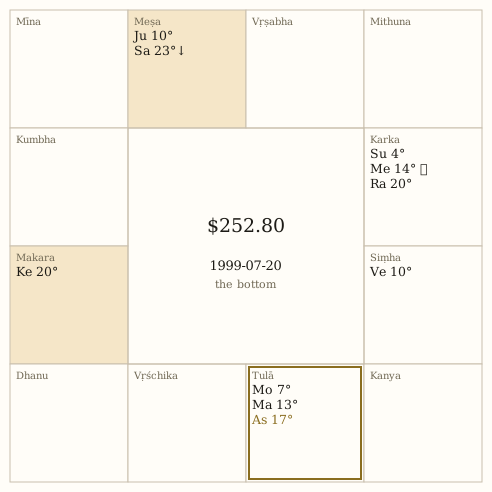
| Planet | Position | House from Meṣa | Band | Gives | Sign quality |
|---|---|---|---|---|---|
| Jupiter | Meṣa 10.28° | 1 | child | 0.50 | friend's sign |
| Saturn | Meṣa 23.07° | 1 | old | 0.50 | debilitated |
| Sun | Karka 4.72° | 4 | dead | 0.00 | friend's sign |
| Mercury | Karka 14.56° | 4 | youth | 1.00 | enemy's sign, ℞ |
| Rahu | Karka 20.36° | 4 | old | 0.50 | — |
| Moon | Tulā 7.04° | 7 | child | 0.50 | neutral |
| Mars | Tulā 13.27° | 7 | youth | 1.00 | neutral |
What gold did. It fell to $252.80, a twenty-year low. In May of that year the UK Treasury said it would sell half the country's gold, and the first auction was held on 6 July.
What the chart shows.
- Meṣa is occupied — Jupiter and Saturn are both sitting in it. Jupiter gives half. Saturn is debilitated, and also gives half.
- Three planets give argala on Meṣa from the 4th house. The Sun is in its last band and probably gives very little. Mercury gives full, but is retrograde and in an enemy's sign. Rahu gives half. Ketu gives virodha argala from the 10th house.
- On Makara, Jupiter and Saturn give argala from the 4th house, worth 1.00. The Moon and Mars give virodha argala from the 10th house, worth 1.50.
- The Moon and Mars aspect Meṣa from the 7th house. Mars is at full strength.
Reasoning
Nothing in this chart is both strong and unblocked.
Meṣa has two planets in it, but both are at half strength and one of them is debilitated. A debilitated Saturn sitting in gold's own sign is a strong mark against gold, and it is the single heaviest thing in this chart.
The argala on Meṣa meets virodha argala from Ketu, and the planets giving it are weak anyway — the Sun probably gives very little and Mercury is retrograde in an enemy's sign. On Makara the virodha argala is the stronger of the two, 1.50 against 1.00.
Mars aspects Meṣa at full strength, and on its own that would help gold. But an aspect is only reinforcement. It cannot outweigh a debilitated planet sitting in the sign itself.
So both of gold's signs are weak, and on both of them the virodha argala holds. Hence we think this is why the gold price may have bottomed that day.
2001-04-02 — gold bottomed at $255.95
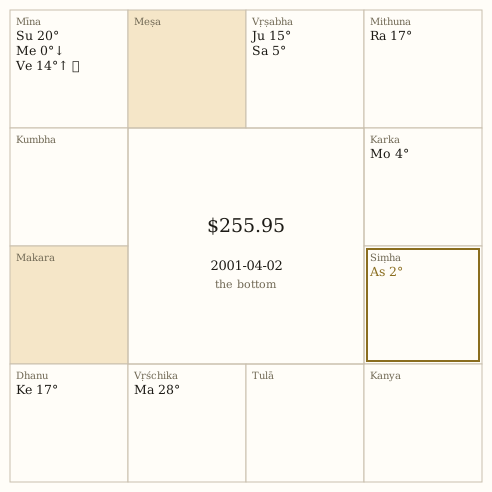
What gold did. It fell to $255.95. This was the end of a long slide, and the start of a rise that ran for the next five years.
What the chart shows.
- Meṣa is empty. No planet is sitting in it.
- Jupiter and Saturn give argala on Meṣa from the 2nd house. Jupiter gives full, from an enemy's sign. Saturn is in its last band and probably gives very little. Three planets give virodha argala from the 12th house, worth 1.50, including Venus at full strength in its best sign.
- The 4th house holds only the Moon. It is in its own sign, Karka, at 5 degrees — its last band in an even sign. It probably gives very little.
- On Makara, Mars gives argala from the 11th house, worth a quarter. Three planets give virodha argala from the 3rd house.
Reasoning
Meṣa is empty, so nothing is sitting in gold's own sign.
The argala on Meṣa from the 2nd house is worth 1.00, all of it from Jupiter, and it is in an enemy's sign. The virodha argala against it is worth 1.50 and includes an exalted Venus at full strength. The 4th house looks better than it is: the Moon is in its own sign, but at 5 degrees in an even sign it probably gives very little. On Makara a quarter-strength Mars is outnumbered three to one.
So neither of gold's signs has anything strong working for it, and what little there is gets outweighed. Hence we think this is why the gold price may have bottomed that day.
2006-05-12 — gold topped at $725.00
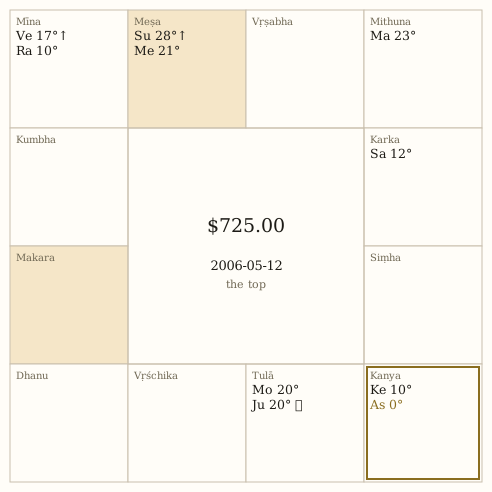
| Planet | Position | House from Meṣa | Band | Gives | Sign quality |
|---|---|---|---|---|---|
| Mercury | Meṣa 21.53° | 1 | old | 0.50 | neutral |
| Sun | Meṣa 28.90° | 1 | dead | 0.00 | exalted |
| Saturn | Karka 12.78° | 4 | youth | 1.00 | enemy's sign |
| Jupiter | Tulā 20.17° | 7 | old | 0.50 | enemy's sign, ℞ |
| Moon | Tulā 20.59° | 7 | old | 0.50 | neutral |
| Venus | Mīna 17.61° | 12 | youth | 1.00 | exalted |
What gold did. It reached $725.00. That was the end of a rise of 183 percent over 61 months, the longest run in the whole record.
What the chart shows.
- Meṣa is occupied — the Sun and Mercury are both sitting in it. Mercury gives half. The Sun is exalted, but at 28.90 degrees it is in its last band and probably gives very little.
- Saturn gives argala on Meṣa from the 4th house at full strength. The 10th house is empty, so there is no virodha argala against it.
- Venus is exalted in Mīna at full strength.
- Jupiter and the Moon aspect Meṣa from the 7th house, both at half strength. Jupiter is retrograde in an enemy's sign. Saturn aspects Meṣa too, by its special 10th aspect from Karka.
Reasoning
Saturn's argala on Meṣa is the strongest thing in the chart. It comes at full strength and nothing stands against it, because the 10th house is empty.
Meṣa is also aspected, and one of those aspects matters more than the others. Jupiter aspects Meṣa from the 7th house, and Jupiter is one of the planets linked to gold. Its aspect on gold's own sign counts for more than an aspect from a planet that has nothing to do with gold. The Moon aspects from the 7th as well, and Saturn adds its special 10th aspect from Karka.
Saturn's argala still stands on its own. Argala works by house position, not by which planet is giving it, so Saturn not being a gold planet takes nothing away from it.
Meṣa is occupied by two planets, and Venus is exalted at full strength elsewhere in the chart.
So gold's own sign has planets in it, an unopposed argala on it, and three aspects on it. Hence we think this is why the gold price may have topped that day.
One thing to notice. The Sun is exalted in Meṣa, which sounds very strong. But the Sun's best degree in Meṣa is 10 degrees, and here it sits at 28.90 degrees. That is its last band, so it probably gives very little. Strong by sign, weak by degree.
2008-03-17 — gold topped at $1,011.25
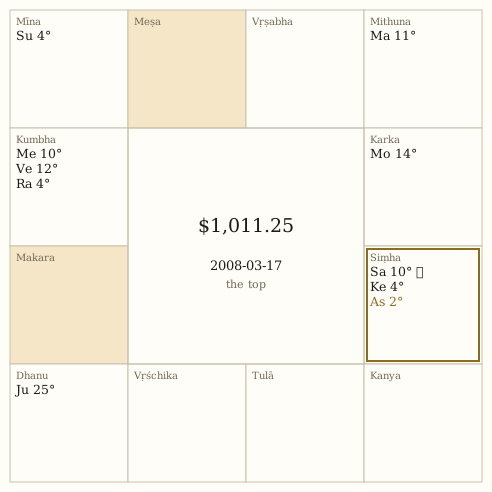
What gold did. It went above $1,000 for the first time, reaching $1,011.25.
What the chart shows.
- The Moon gives argala on Meṣa from the 4th house at full strength, from its own sign Karka. The 10th house is empty, so there is no virodha argala against it.
- Mercury, Venus and Rahu give argala on Meṣa from the 11th house, worth 1.75, with Venus at full strength. Mars gives virodha argala from the 3rd house, worth half, from an enemy's sign.
- The same three planets give argala on Makara from the 2nd house. Jupiter gives virodha argala from the 12th house, but at 25.44 degrees it is in its last band and probably gives very little.
Reasoning
Both of gold's signs have argala on them, and almost nothing standing against it.
On Meṣa the Moon gives argala from the 4th house at full strength with the 10th house empty, and a further 1.75 comes from the 11th house against only 0.50 of virodha argala. On Makara the virodha argala comes from a Jupiter that probably gives very little, so the 2nd house argala arrives almost untouched.
Hence we think this is why the gold price may have topped that day.
What comes next
We would like to start a monthly gold forecast: a reading for the month ahead, and then a look back once the month is over to see how it held up. That is how we hope to strengthen this research.
Frequently asked questions
- Which signs represent gold?
- The Bṛhat Saṃhitā gives gold two signs: Meṣa (Aries) and Makara (Capricorn). We use both, and they are shaded in every chart. Planet positions are counted from those two signs.
- Which planets are linked to gold?
- In the Graha-gocara material, the Sun is linked to gold and copper, Mars to gold and mines, and Jupiter to gold, silver and ornaments. The Moon is linked to pearls and silver, and Venus to silver and crystal.
- What is argala?
- Argala means an intervention. A planet in the 2nd, 4th or 11th house from a sign acts on what that sign stands for. The 5th house gives a weaker one. A planet in the house opposite — the 12th, 10th, 3rd or 9th — blocks that action. Counting planets is not enough. How strong each planet is decides how much of its effect actually arrives.
- What are avasthās?
- Each sign is 30 degrees wide. Split it into five bands of six degrees each. Where a planet sits among those bands decides how much of its result it can give: a quarter in the first band, half in the second, all of it in the third, half in the fourth, and nothing in the fifth. In even signs the order runs the other way. This is why a planet can be exalted and still give very little.
- How were these dates chosen?
- From the London gold prices only. We looked for days when gold changed direction after a long rise or a long fall. A fall of 20 percent marks a turn, and any peak with a rise of at least 25 percent behind it counts as a top. Choosing the days this way, before looking at any chart, matters. It stops us picking the days that happen to suit us.